Radio (RF) waves of EMR are a combination of an electric field and a magnetic field that oscillate while traveling at the speed of light. In the EMR spectrum, RF waves have the lowest frequencies and longest wavelengths.
Each radio transmitter uses a process of imposing an input signal onto a carrier wave. The transmitter modulates the carrier wave prior to transmission. At the radio receiver, information is extracted by demodulation.
In RF (Radio Frequency), modulation is the essential process of encoding information such as voice, data, or video, onto a carrier wave by systematically changing the carrier's amplitude, frequency, or phase. This process allows RF signals to travel over long distances making it practical for communication using radios, Wi-Fi, GPS and mobile phones.
Frequency Modulation (FM): carrier frequency varies.
Phase Modulation (PM): carrier phase varies as in phase shift keying (PSK) or quadrature amplitude modulation (QAM).
Data Modulation uses various modulation types.
Effective RF communications depend on clear distortion free signals. Comparing power levels, both signal and noise, is necessary in order to evaluate signal quality.
WIRELESS SIGNAL POWER [ dB, dBm and dBW ]
In the world of RF math, converting power levels to decibels is the preferred approach. Decibels, abbreviated as dB, are a basic unit of measurement for RF signals that vary logarithmically, not linearly. Decibels are useful when expressing values with large differences in magnitude. On the dB scale, signal gains and losses are calculated using numbers that provide a measurement of relative RF signal strength. Small or low level signals may be negative dB numbers while large or strong signals are positive dB numbers.
Decibels are used to define the relative difference when comparing two or more signals. These hardware examples compare the input signal of a device to the output signal:
An antenna with a gain of 4.3 dB.
Connection cable with a 6.5 dB loss.
RF inline attenuator with a 10 dB loss.
Both dBm and dBW use a set reference point in order to compare signal power levels.
dBm (dB-milliwatts) zero dBm is defined as one mW of power (0.001 Watt). One mW is the reference point for units of dBm. A value of 30 dBm is equal to 1,000 mW or one watt of power.
0 dBm = 1 mW and 1 mW = -30 dBW
30 dBm = 1 watt and 1 watt = 0 dBW
dBW (dB-Watts) zero dBW is defined as one watt of power and one watt is the reference point for units of dBW.
Convert dBW to dBm: dBm = dBW + 30 dB; e.g. 5 dBW = 35 dBm
Convert dBm to dBW: dBW = dBm – 30 dB; e.g. 18 dBm = -12 dBW
If ax = n then x = loga (n).
Convert dBm to power: P(W) = 10(( dBm - 30 dB) / 10)
35 dBm = 3.16 W; -12 dBm = ? 21 dBm = 126 mW
Convert power to dBm: P(dBm) = 10 x log10 (power in watts) + 30 dB
5 W = 37 dBm; 100 W = 50 dBm; 0.025 W = 14 dBm
0.001 mW = 0.000001 W = -30 dBm
Logarithms are the opposite of exponents. Logs are used when things grow exponentially but are measured on the smaller logarithmic scale: 103 = 1000 becomes log10 1000 = 3; log10 100 = 2; log10 23 = 1.36; log10 1 = 0; log10 0.0027 = -2.57; log10 0.000006 = -5.22. Using logarithms reduces complex math into simple addition, making wide ranges of values manageable.
Using dB power values, it is possible to calculate the voltage on the antenna input of a radio receiver. An understanding of the ambient RF background noise level is necessary to determine the minimum required signal level for detection on a receiver, by a radio operator.
THERMAL NOISE POWER
Black-body radiation is a theoretical concept used in determining the thermal energy, in the form of EMR, emitted by every object, based solely on its temperature. This radiation is generated by the motion of charged particles (electrons) within the object and is directly proportional to its temperature. The Boltzmann Constant kB is a fundamental physical measure of the average energy, in joules, of a particle to its absolute temperature, in Kelvin. Use of a capitol “K” is the symbol for the Kelvin scale and the Kelvin scale is considered absolute due to the fundamental limit of zero thermal energy at zero Kelvin.
Power = energy / time, or one watt of power is defined as one joule of energy dissipated per one second or one Hertz. Substitute for the units in Joules and kB is now expressed as the amount of thermal noise power in watts per hertz per Kelvin.
The following examples use an ambient temperature (Ta) of 59°F or 15°C which equates to 288K.
Bandwidth (BW) is the difference between the highest and lowest frequencies in a modulated signal used for transmitting information, representing the "space" it occupies in the electromagnetic spectrum. A wider bandwidth means more capacity allowing for a faster transfer of information, while a narrower bandwidth is good for isolating weak signals.
Thermal noise power is calculated by multiplying kB times Ta times BW. The result is converted to dB-Watts and expressed in dB-milliwatts.
Thermal noise power = 10 x log10 (kB x 288 K x 1 Hz) + 30 dB = -174 dBm/Hz.
The thermal noise power (kBTaBW) is: -174 dBm/Hz with a noise bandwidth of 1 Hz at a Ta = 59°F. There is a minimum of -174 dBm/Hz of noise present within every Hertz (Hz) of the RF spectrum.
APPLYING NOISE POWER TO TRANSMITTED SIGNALS
This formula is used to find the thermal noise floor at a given bandwidth:
thermal noise floor = -174 dBm/Hz + [10 x log10 (50 Hz)] = -157 dBm
| Transmission Type | Bandwidth | thermal noise floor | Data Speed |
|---|---|---|---|
| WiFi 7, 59 channels | 160 MHz | -92 dBm | 46 Gbps |
| WiFi 6, wider channels | 80 MHz | -95 dBm | 9.6 Gbps |
| WiFi 5, 25 channels | 40 MHz | -98 dBm | 3.5 Gbps |
| WiFi 4, 11 channels | 20 MHz | -101 dBm | 0.6 Gbps | FM (voice) | 175 kHz | -122 dBm | na |
| FM (voice) | 20 kHz | -131 dBm | na |
| AM (voice) | 10 kHz | -134 dBm | na |
| SSB (voice) | 2.4 kHz | -140 dBm | na |
| RTTY (radio teletype) | 1 kHz | -144 dBm | 50 bps |
| CW (Morse code) | 500 Hz | -147 dBm | 30 wpm |
| FT8 Weak signal + DSP | 50 Hz | -157 dBm | 10 bps |
The wider the bandwidth, the stronger the noise power and the noise power determines the thermal noise floor. In order to define a clean signal, other sources of noise must be taken into consideration.
The Noise Figure, internal to each receiver, is the noise generated by the electronics of the receiver.
External noise sources include atmospheric noise, cosmic noise and man-made interference. The actual noise floor of a receiver encompasses all of the RF energy within a given frequency range with the exception of the intentional signaling energy.
To compare signals and noise levels, the signal-to-noise ratio (SNR) is a very convenient indicator. To determine the SNR, for a given transmitted signal, we need to know its strength at the point of reception minus the actual noise floor. The difference between these two values is the SNR, measured in dB. If the SNR value is greater than 0 dB, the signal power is greater than the noise power.
For example, an AM broadcast with a signal strength of -102 dBm with a receiver noise floor of -128 dBm. The result is a signal-to-noise ratio of 26 dB which results in very good audio quality and clarity.
An FM broadcast, with a signal strength of -112 dBm with a receiver noise floor of -116 dBm would have a signal-to-noise ratio of 4 dB. An SNR of 4 dB is marginal for an FM transmission and less than 4 dB is likely unusable.
SNR is also calculated as a ratio of signal power: 10 x log10 (signal power in watts / noise floor power in watts)
SSB EXAMPLE
The next two examples determine the minimum detectable input voltage at the antenna connection point of a radio receiver with a 50 ohm input impedance. The value of Vin is the strength of the weakest operator detected signal.
Transmitted signals on single-side band (SSB) have a bandwidth of 2400 Hz and a thermal noise floor of -140 dBm. In this case, the receiver has a Noise Figure of 3 dB. Add -140 dBm + 3 dB producing an actual noise floor of -137 dBm. SSB communication typically requires an SNR of +6 dB resulting in a minimum detectable signal strength also known as minimum discernible signal (MDS) of -131 dBm.
Convert the MDS from milliwatts to watts: -131 dBm – 30 dB = -161 dBW.
Vin = (R x P)(1/2)
Vin (2400 Hz) = square-root (50 ohms x 10[-161/10]) = 6.30 x 10(-08) or 63.0 nV.
For a detectable signal on SSB, the minimum voltage at the receiver input is 63 nano-volts.
FT8 EXAMPLE
FT8 (8 base tones) is a weak-signal mode that relies on digital signal processing (DSP) and is used to contact distant stations. With a bandwidth of 50 Hz, FT8 has a very narrow bandwidth and uses forward error correction (FEC) to reconstruct partial messages. FT8 signals are modulated using Gaussian* frequency shift keying (GFSK). Prior to transmission, a pulse shaping filter provides smoothing of the frequency transitions resulting in better immunity to noise and interference while enhancing reliability. FT8 provides a vehicle for the communication of small message payloads (174 bits) over thousands of miles at relatively low power in high noise environments.
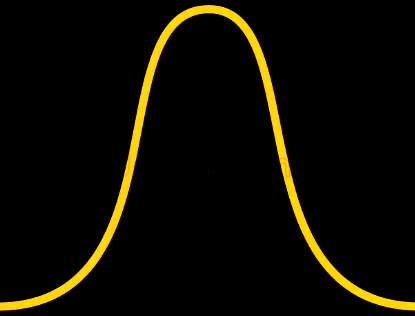
*A Gaussian waveform is similar to a bell curve which limits noise due to overshoot.
For an FT8 signal, with a thermal noise floor of: -157 dBm on a receiver with a Noise Figure of 5 dB along with 10 dB of atmospheric noise, the actual noise floor is: -142 dBm. But FT8 communication is capable of detecting signals 6 dB below the noise floor so the minimum SNR for FT8 is -6 dB resulting in a minimum detectable signal strength (MDS) of: -142 dBm - 6 dB = -148 dBm.
Convert the MDS for FT8 to dB watts: -148 dBm – 30dB = -178 dBW.
Vin (50 Hz) = square-root (50 ohms x 10[-178/10]) = 8.9 x 10(-09) or 8.9 nV.
The minimum detectable input voltage is 8.9 nV (nano-volts). FT8 transmissions are detected using a remarkably small signal even in noisy environments. Other weak signal digital modes include short range applications such as Bluetooth and the Internet of Things (IoT).
Originators: Michael Faraday, James Clerk Maxwell, Heinrich Hertz, Ludwig Boltzmann, Max Planck, Alexander Graham Bell, Guglielmo Marconi.